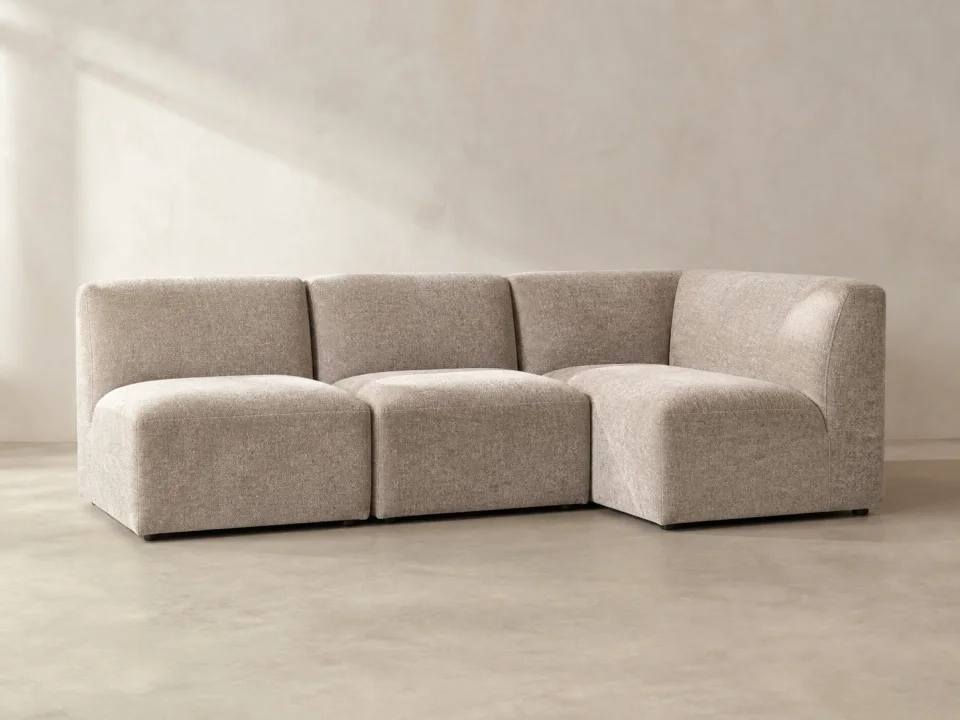
Armless seat
The repeatable center unit establishes seat width, depth and the rhythm of straight layouts. It can become a chair, extend a sofa or fill the center of a sectional. Side seams and upholstery direction should align when units meet.
 Request a quote
OEM configurable foam seating · China
A useful modular range does more than separate a sofa into pieces. Each unit must work alone, align with its neighbors, fit the configuration logic and arrive in a carton customers can identify. ALF Home develops the module system and the retail system together.
Direct answer
A modular compression sofa is a seating system built from separate units—such as armless seats, corners, chaises and ottomans—that can be arranged in more than one layout and vacuum packed for reduced shipping volume. The modules may be sold individually, bundled as fixed configurations or used to create a family of retail SKUs.
The buyer is sourcing both furniture and a configuration language. Module dimensions, upholstery direction, connectors, carton codes, product photography and customer instructions all need to agree. A small inconsistency can multiply across every layout in the range.
Module architecture
A disciplined module set creates more choice with fewer unique constructions. The goal is not maximum variety; it is a system that remains clear to buyers, warehouses and customers.
The repeatable center unit establishes seat width, depth and the rhythm of straight layouts. It can become a chair, extend a sofa or fill the center of a sectional. Side seams and upholstery direction should align when units meet.
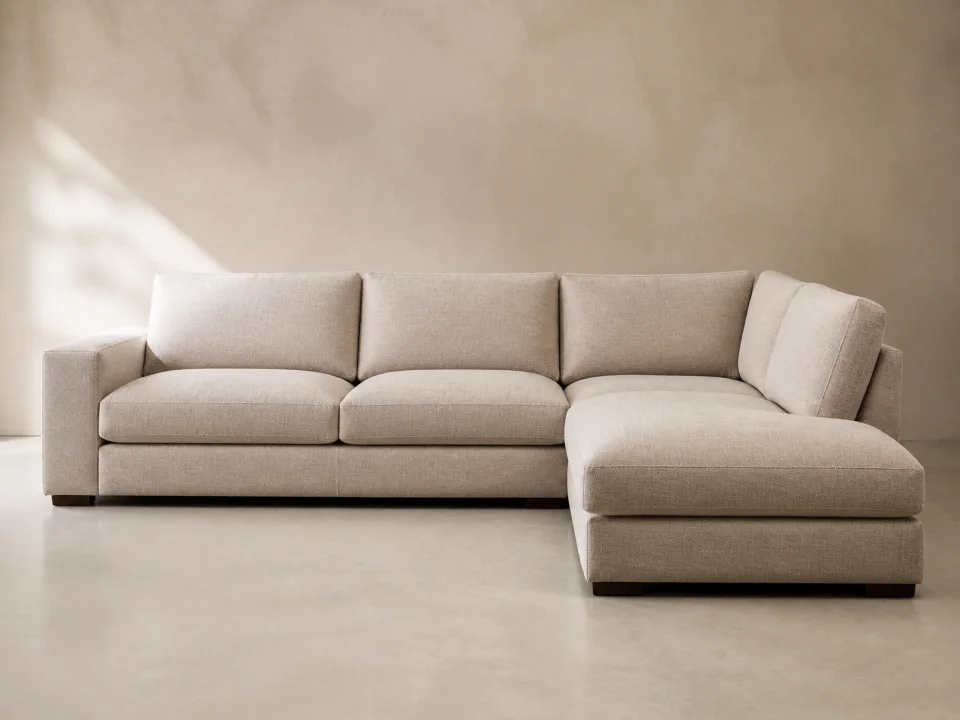
A corner changes the direction of the layout and must offer usable support from more than one angle. Its footprint, back geometry and neighboring seat relationship require particular sample review.
End modules can add a shaped arm or finished side. Clear left/right naming is essential: define orientation from the seated customer’s perspective and use the same convention in ERP data, cartons and instructions.
A movable ottoman can serve as footrest, occasional seat or chaise extension. Height, top feel and surface movement should coordinate with the main seats even when the shape is simpler.
Configuration planning
A small module library can create a two-seat sofa for an apartment, a straight three- or four-seat configuration, an L-shaped sectional or an open U-shaped conversation area. That flexibility is commercially valuable only when every combination has an accurate bill of components.
Retail names should map to module codes. If a listing calls a configuration “four-seat with chaise,” the product data, warehouse pick list, carton labels and setup diagram must describe the same units. Photography should show the exact combination being sold, not a visually similar arrangement.
Brands that allow customers to add modules later should also consider color-lot variation and dimensional continuity. A future unit needs to meet the earlier product closely enough to connect and look intentional. This makes change control more important than in a one-off sofa.
Private label directions
These examples are development formats rather than stocked SKUs. Dimensions, colors, materials, connectors and packaging are approved per project.
Repeatable
The basic building block for chairs, straight sofas and larger configurations. Consistent width, height and seam placement make repeated units read as one system.
Directional
The turning point in L-shaped and U-shaped layouts. Back support, sitting direction and adjacent module gaps should be checked from several positions.
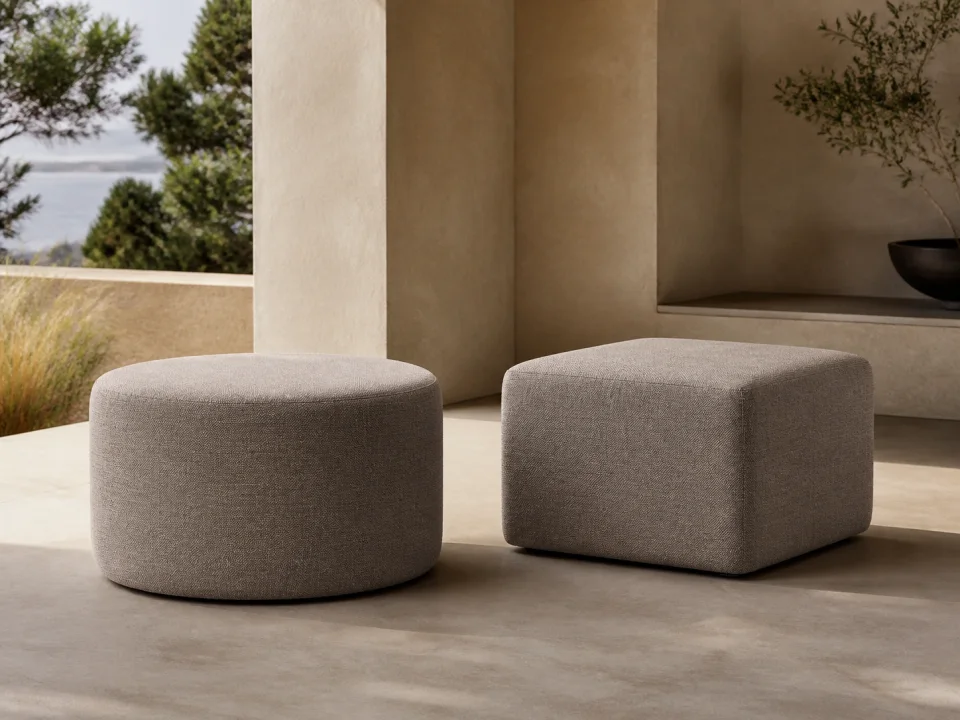
Flexible
A compact extension that supports multiple merchandising stories. The top plane can align with the seat for lounging or stand independently as an accent.
Alignment and movement
Separate foam units can shift when customers sit down or change position. Weight, base material, floor type and the chosen connection method all affect movement. Some designs rely on anti-slip surfaces and product mass; others use hook-and-loop elements or dedicated connectors. The appropriate method depends on the construction and the promise made to customers.
Testing should cover common floor surfaces, not only the sample-room floor. Connectors must be accessible without creating uncomfortable hard points, and customers need to understand whether the product is designed to lock together or remain freely movable.
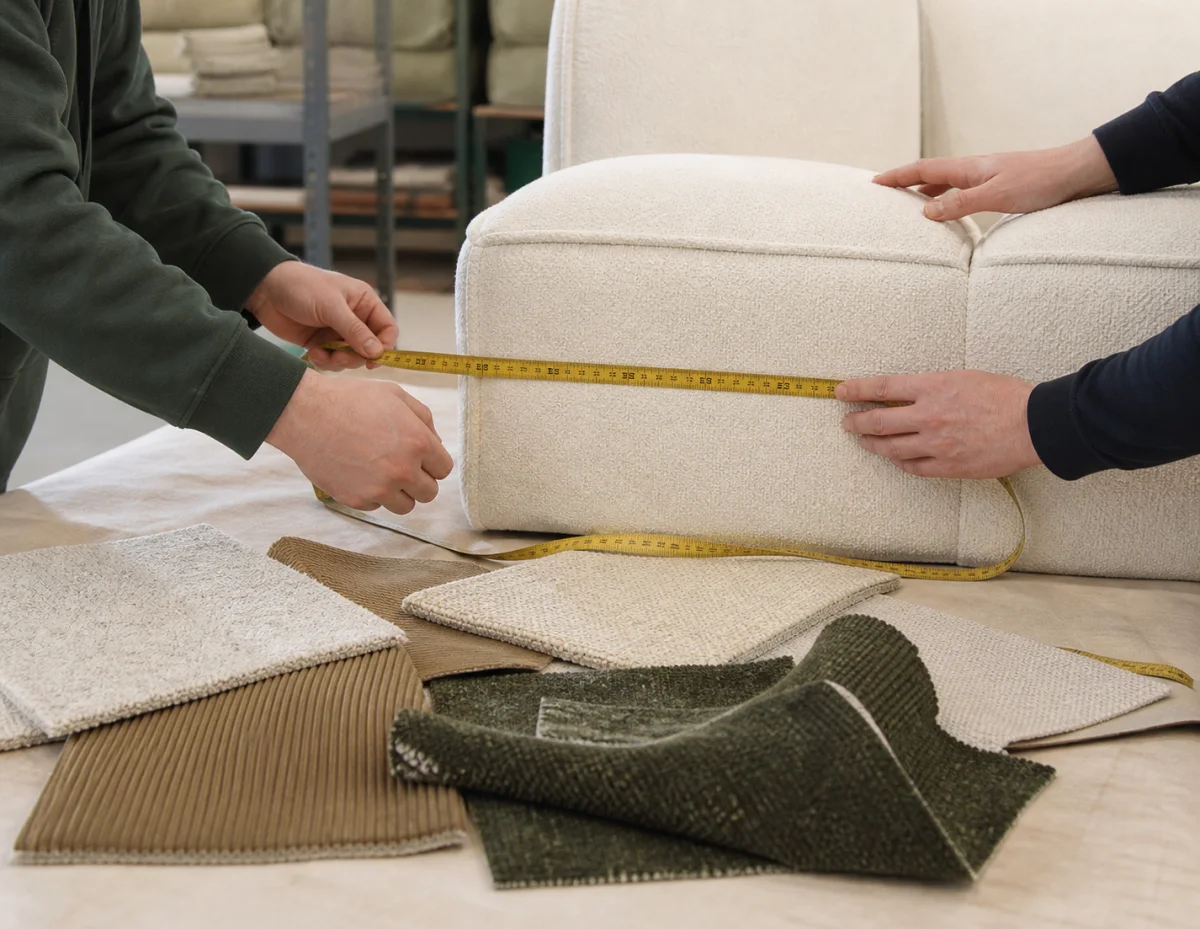
Alignment is visual as well as mechanical. Seat heights, front edges, back lines and fabric direction should remain consistent across units. Review the quality control process for how dimensional and appearance checkpoints can be documented.
Commercial architecture
A modular range can become operationally heavy when names, component lists and images are not controlled from the beginning.
Give every physical unit a stable short code. Use it on technical drawings, product labels, cartons, packing lists and replacement discussions.
Create a separate code for the sellable bundle. Its bill of materials lists the exact module quantity, orientation, fabric and color.
Link the configuration code to approved photography and diagrams. Customers should see the same arrangement that the warehouse ships.
Where a configuration uses multiple cartons, show the total carton count and identify each box. Missing-box claims become easier to investigate.
If modules can be purchased later, state compatibility rules and any color-lot limitations. Avoid implying unlimited backwards compatibility.
Decide whether covers or individual modules can be supplied separately and how the team will match the original specification.
Compression and cartons
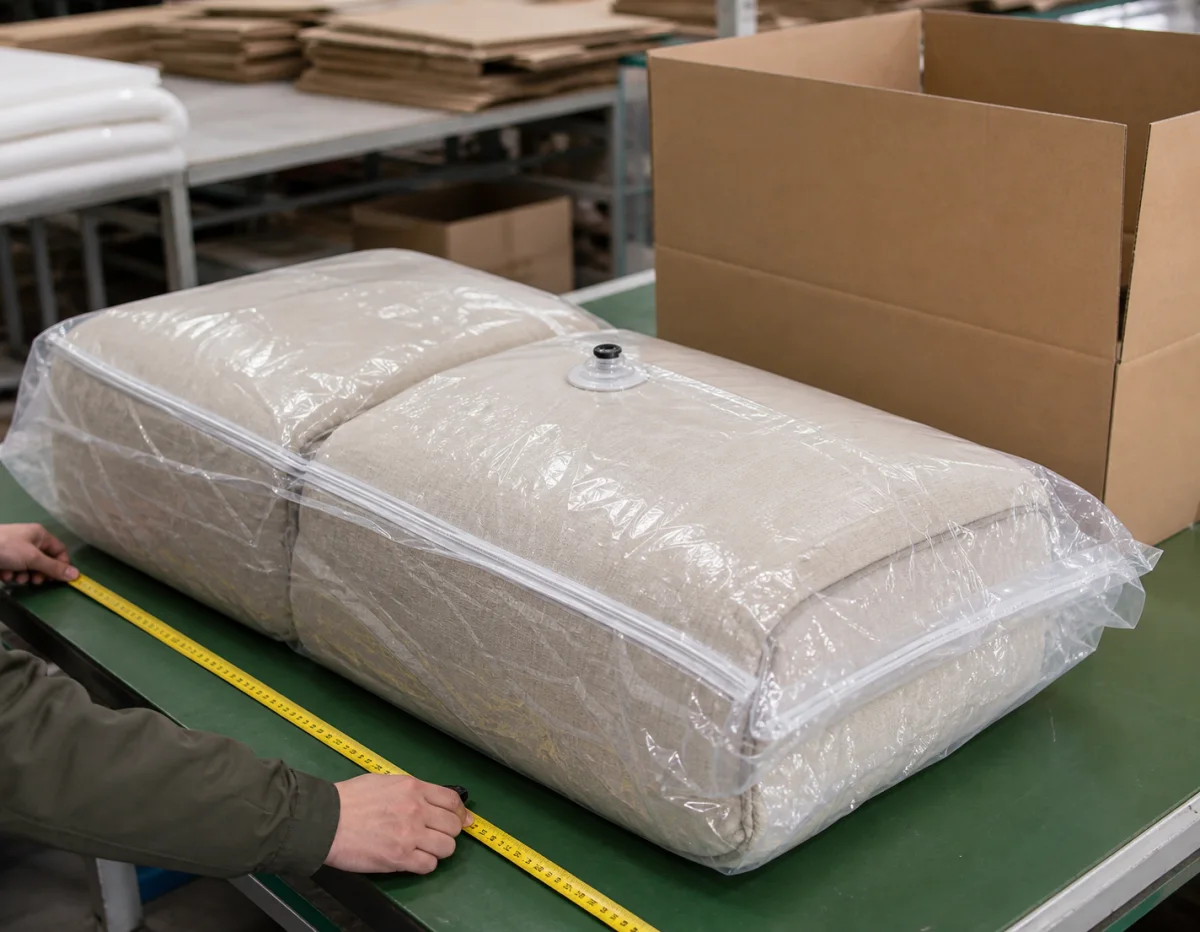
Modular furniture can improve logistics because units are smaller than one large finished sectional. Vacuum compression may reduce each module further, subject to foam, fabric and recovery testing. The advantage disappears if cartons are difficult to identify or if one missing box makes the configuration unusable.
Package trials establish protective-bag size, compression method, carton dimensions, gross weight and recovery behavior for each module type. Retail configurations then use those verified module packages as building blocks. For mixed containers, a current loading plan should reflect the actual configuration mix rather than a theoretical single-SKU maximum.
Customer inserts need an inventory step: identify all modules, confirm orientation and show the intended arrangement. More detail is available in our compression packaging guide.
Supplier qualification
ALF Home’s manufacturing business was registered on June 28, 2012. The company profile records 14 years of furniture-industry and export experience, a reported 250,000 m² building area and annual export revenue of US$10,965,053. Commercial communication is available in English.
FSC, two CE documents and REACH documentation are recorded as available for review. Buyers should check certificate number, issuer, validity, tested materials and relevance to the selected modular system and destination market.
Modular sofa FAQ
Final module behavior and commercial details depend on the approved system.
It is a seating system made from separate units that can create different layouts and be vacuum packed for shipping. Common units include armless seats, corners, chaises and ottomans.
Modules may rely on weight and anti-slip bases or use approved connectors. Test the chosen method on intended floor types and explain it accurately in customer instructions.
Yes. A controlled library can create a chair, loveseat, straight sofa, L-shape, U-shape and chaise layout. Each sellable configuration still needs its own component list, images, carton codes and instructions.
They can be evaluated. Zipper access, cover tension, washing guidance and refitting difficulty need review, and the final construction must match the marketing claim.
Use module names or codes that match the packing list, retailer data and configuration guide. Include orientation, color, fabric and carton sequence where relevant.
Content responsibility
Module, packaging and sourcing guidance was reviewed for practical consistency. No connector performance, carton size, compatibility period, MOQ, loading quantity or lead time is claimed without an approved system and current project conditions.
Last reviewed: August 11, 2026 · About the manufacturer · Request a module review
OEM modular program
Share the target configurations, room sizes, sales channel, fabric direction and order estimate. We will help organize the module library before sampling.
Plan your modular range