
OEM development · Buyer guide
The OEM compression sofa process, from brief to shipment.
A reliable OEM program is a sequence of controlled decisions. Product form, materials, workmanship, packaging and commercial terms move together, with clear approval gates before production commitments increase.

A gated process protects both speed and repeatability
The typical route is discovery, feasibility, specification, prototype, revision, golden-sample approval, packaging validation, pre-production release, manufacturing, inspection and shipment. Some activities overlap, but approval authority should remain visible.
Timing cannot be promised from a generic flow alone. Complexity, material availability, sample rounds, testing and buyer response time determine the real schedule.
01 · Discovery
Convert market intent into a usable development brief.
Define customer, destination, channel, use, dimensions, style references, comfort direction, target quantity and logistics constraints. Label goals separately from mandatory requirements.
Reference images communicate mood but rarely settle rear views, undersides, seam paths or internal construction. Record those gaps.
Translate this point into an approval item for oem process. Name the SKU, responsible reviewer, reference sample, document revision and decision date. If the requirement cannot yet be measured, describe the visual or user outcome and retain photographs from a consistent angle. That record gives production and inspection something more useful than a general preference about convert market intent into a usable development brief. It also gives a later buyer enough context to distinguish a deliberate product decision from an undocumented deviation, reducing repeated debate when the collection is reordered, expanded into another color or reviewed by a different quality team.
02 · Feasibility
Resolve conflicts before detailed sampling.
Engineering reviews foam geometry, upholstery, access, module connections, compression route, carton target and manufacturing method. Purchasing checks material availability and minimums.
Present tradeoffs explicitly: a deep curve may affect cover fit, a textile may mark after compression, or a small carton may increase recovery risk.
During sample review, evaluate resolve conflicts before detailed sampling on the complete product rather than on an isolated material swatch or component. Record the starting condition, the requested change and the observations after that change. Recheck connected features such as dimensions, seam location, sitting response and packaging whenever the adjustment can move an earlier approval.
03 · Specification
Create one controlled product definition.
The file should connect drawings, bill of materials, foam and textile codes, colors, seam map, labels, accessories, workmanship, packaging and required evidence.
Give revisions dates and approval owners. Verbal decisions should be returned to the controlled record.
For an RFQ, state the market, quantity and intended claim behind create one controlled product definition. Suppliers may propose different technical routes, but each route should disclose material assumptions, sample work, testing needs and effects on MOQ or timing. Keeping alternatives visible prevents a low headline price from silently describing a different product.
04 · Prototype
Use the first sample to learn, not to pretend finality.
Review posture, useful sitting area, proportions, transitions, fabric behavior, sewing, symmetry and manufacturability. Measure from agreed points after conditioning.
Classify comments as required correction, optional refinement or observation. That prevents uncontrolled preference changes.
When a source, color, foam zone, pattern or packing method changes, reopen the decisions affected by use the first sample to learn, not to pretend finality. “Equivalent” is not a result until relevant properties and the finished sample have been compared. The change record should identify why the revision was accepted and which earlier tests or appearance references remain applicable.
05 · Golden sample
Freeze the reference with supporting documents.
Approval should name the sample revision and any signed deviations. Photographs help distributed teams, but they do not replace materials, dimensions or tactile reference.
Control access and storage so a damaged or outdated sample is not used on the line.
The evidence file for freeze the reference with supporting documents may combine drawings, material codes, photographs, measurements, trial notes and third-party reports. These items answer different questions. Keep the model and revision attached to every record so a later team does not apply a result from one construction to another sofa that merely looks similar.
06 · Packaging trial
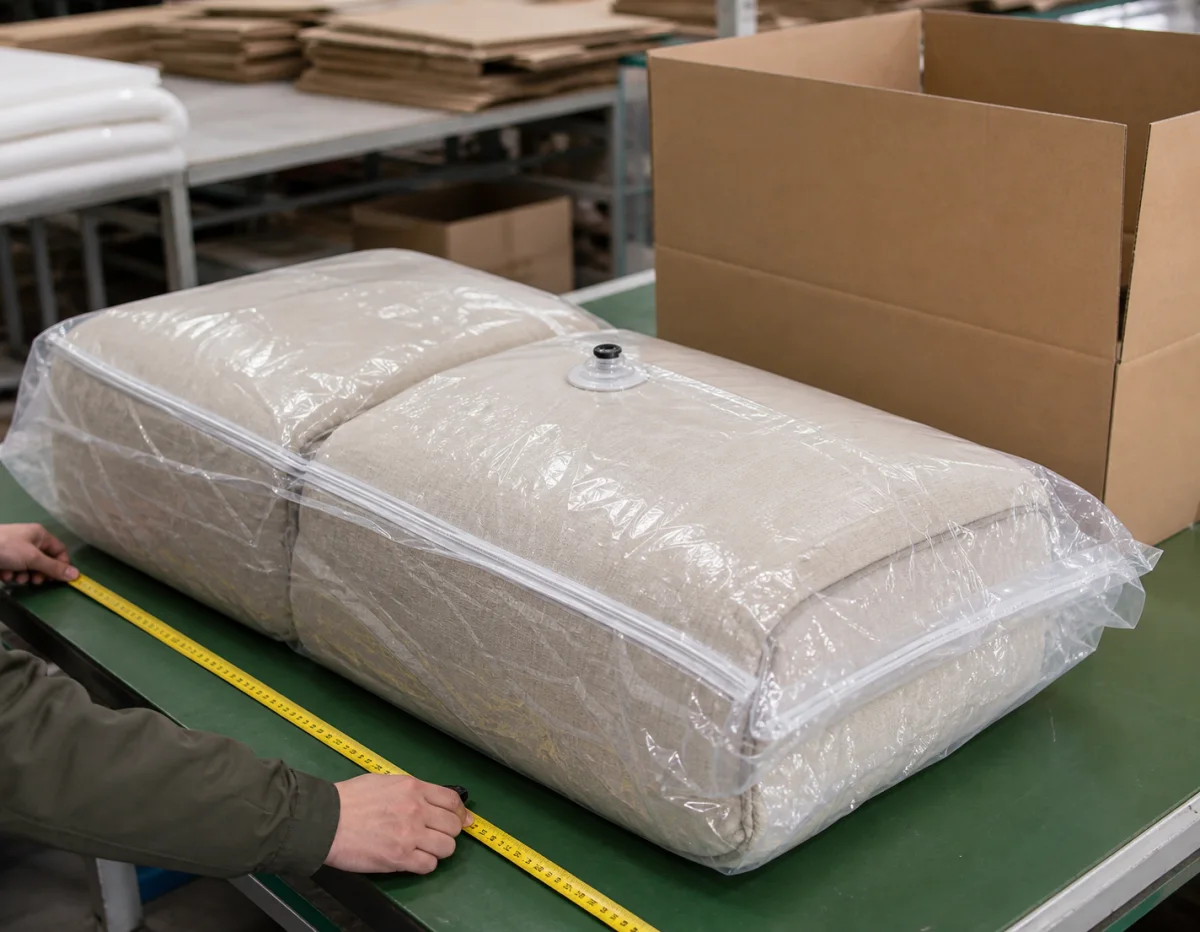
Validate the product after the intended pack route.
Set bag, fold or roll method, protective parts, carton, storage history and opening instructions. Check package integrity and recovered appearance, dimensions and function.
If packaging changes after approval, determine which trials must be repeated before release.
Retail language should describe validate the product after the intended pack route at the same level the evidence supports. Avoid turning a conditional trial observation into words such as always, instant, waterproof, maintenance-free or guaranteed. Clear dimensions, setup steps, limitations and care instructions help the customer understand the actual product and give after-sales teams a fair reference.
07 · Pre-production
Make readiness visible across teams.
Confirm approved materials, supplier lots, patterns, tools, work instructions, inspection criteria, labels, cartons, tests, quantities and schedule. Close or formally accept open risks.
A pre-production meeting is useful when decisions are captured with owners and due dates.
Inspection of make readiness visible across teams needs a repeatable viewpoint. Define product conditioning, placement, measuring points, lighting or configuration where relevant, then distinguish a one-off workmanship issue from a repeated process pattern. Sampling and acceptance can be set for the real order instead of copied from an unrelated furniture program.
08 · Production
Control the process where defects are created.
Incoming checks protect material identity. First-piece review confirms setup. In-process checks cover foam construction, bonding, sewing and cover fit before packing hides the product.
Lot and revision records make later investigation more reliable.
Commercially, control the process where defects are created can influence material minimums, sample rounds, carton development, test cost and launch timing. Put those dependencies next to the quotation rather than discussing them after price approval. A buyer can then decide whether to protect the feature, simplify it or move it into a later collection revision.
09 · Release
Inspect the product, package and documents.
Final checks follow the purchase specification and approved sampling plan. Pack-out verification covers SKU, accessories, labels, instructions and carton. Selected recovery audits may confirm the production route.
Shipment release should identify unresolved exceptions and authorized disposition, not rely on an informal assurance.
Responsibility for inspect the product, package and documents is shared but should not be vague. The buyer defines market intent and acceptance; development translates it into a buildable standard; production controls the released method; quality records conformance; marketing stays within verified claims. Clear ownership reduces the risk that one team assumes another approved the detail.
- Approved product revision
- Order quantity by SKU
- Inspection record
- Packing list and carton marks
- Required evidence
- Exception approvals
Put the guide to work
Turn oem process into a decision record.
Begin with the actual model and destination rather than a category assumption. The first review should connect convert market intent into a usable development brief, resolve conflicts before detailed sampling and create one controlled product definition. Record which statements are confirmed by drawings or samples, which rely on supplier information and which still need a packaging trial, inspection or third-party test.
Next, assign decisions to people and dates. The buyer owns the market promise and final acceptance. Product development owns the translated specification. Purchasing protects approved material identity, production follows the released method, and quality records the agreed evidence. When use the first sample to learn, not to pretend finality or freeze the reference with supporting documents changes, reopen every dependent approval instead of treating the revision as isolated.
Finally, keep the quotation and retail copy inside the same evidence boundary. MOQ, price, lead time, carton data and performance language can only be as reliable as their disclosed assumptions. This approach may take more questions at the beginning, but it creates a clearer sample review and a more defensible purchase order.
Topic cluster · OEM Manufacturing & Quality
Continue from explanation to a sourcing decision.
This guide belongs to a connected evidence path. Use the commercial overview for scope, the category archive for the complete subject, and the adjacent guides for the questions that normally follow.
Article FAQ
Short answers for the next decision.
How many sample rounds are required?
There is no universal number; complexity and review quality determine it.
Can packaging develop before the sofa is final?
Exploration can overlap, but final pack validation needs the released construction.
Who approves the golden sample?
The buyer’s authorized decision maker and the supplier should record the same revision.
What triggers reapproval?
Material, construction, dimension, cover, supplier or packaging changes may do so.
Does final inspection replace process control?
No. Hidden construction and material identity need earlier controls.
Editorial responsibility
Editorial and technical review
The process is a planning framework; actual sequence, responsibility and timing are confirmed per project.
Updated: August 11, 2026 · About the publisher · Ask about a project